

Front-of-Knee Pain Keeping You From Running, Jumping, Squatting, or Going DownStairs Comfortably?
Does This Sound Familiar?
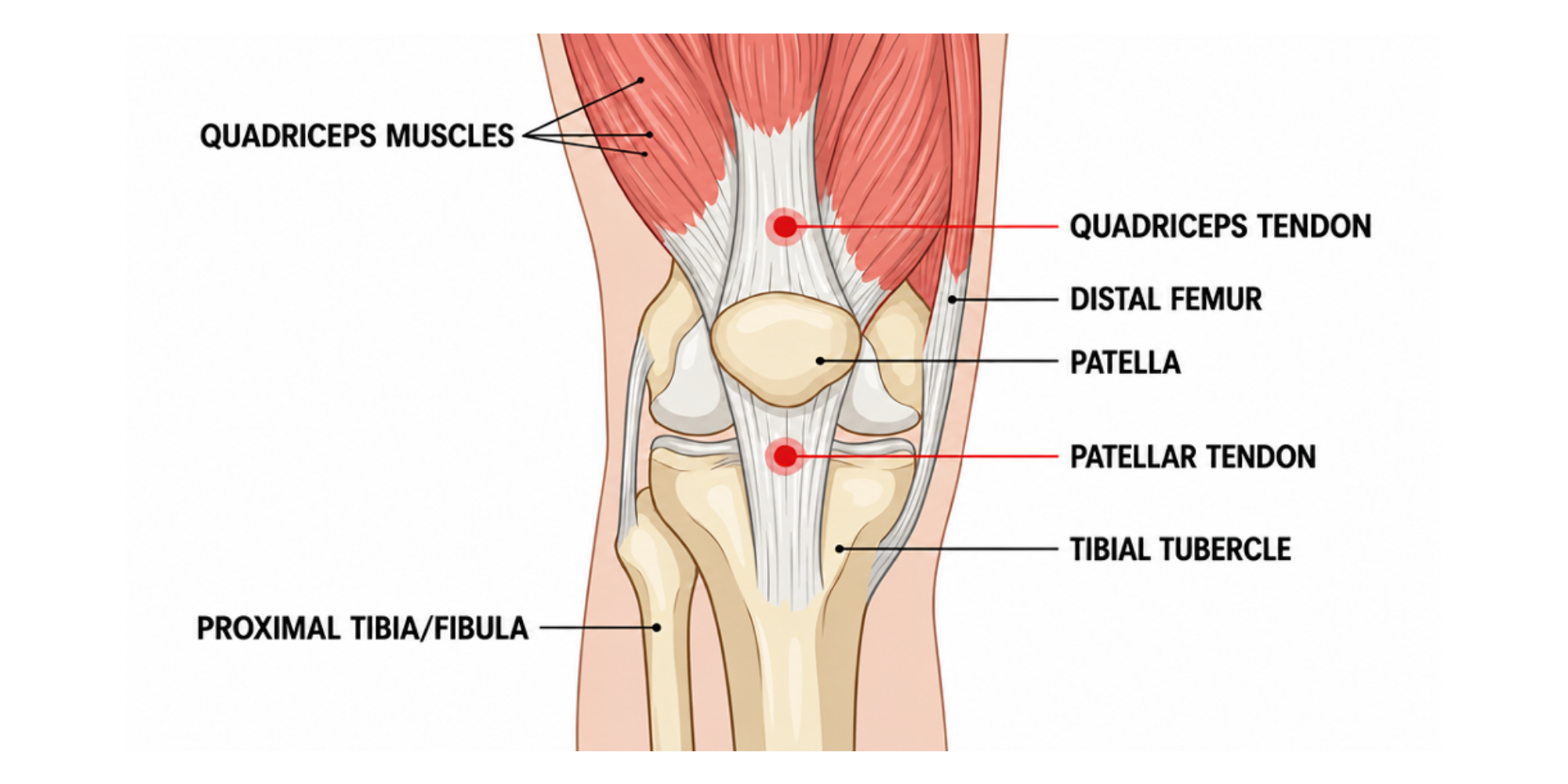
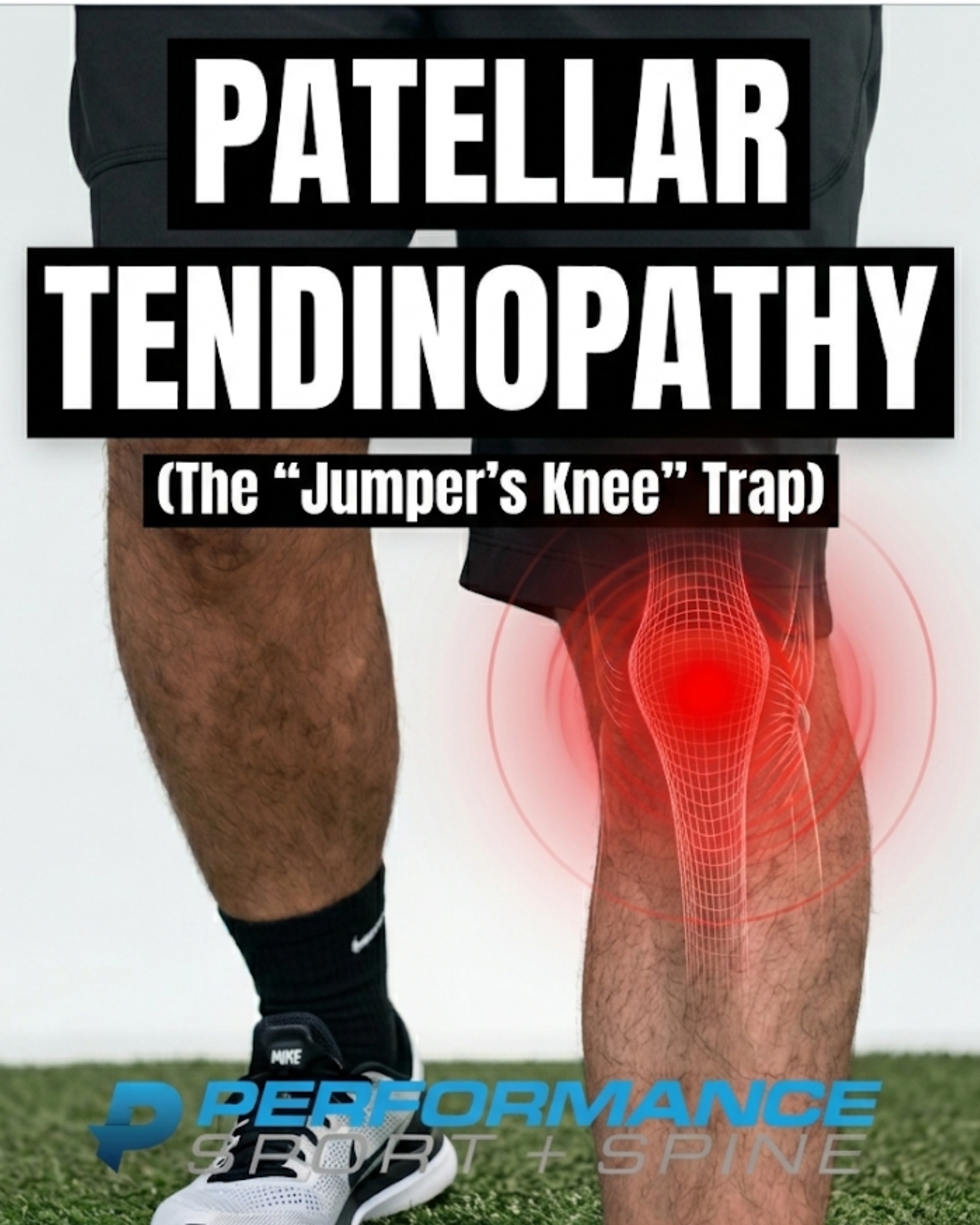
If pain at the front of your knee is disrupting your training or daily routine, you’re not alone. Patellar tendinopathy (often called “jumper’s knee”) can make everyday activities painful when your knee handles repeated jumping, landing, or high-load movements.
You may be dealing with patellar tendinopathy if you experience:
-
Pain localized precisely to the tendon just below your kneecap during squats, jumps, or runs
-
Discomfort when walking downstairs or hiking downhill
-
Morning stiffness or aching at the start of an activity that eases with a warm-up, but flares up afterward
-
Symptoms that temporarily improve with rest, only to return when activity increases (Malliaras et al., 2015)
 What Causes Patellar Tendinopathy?
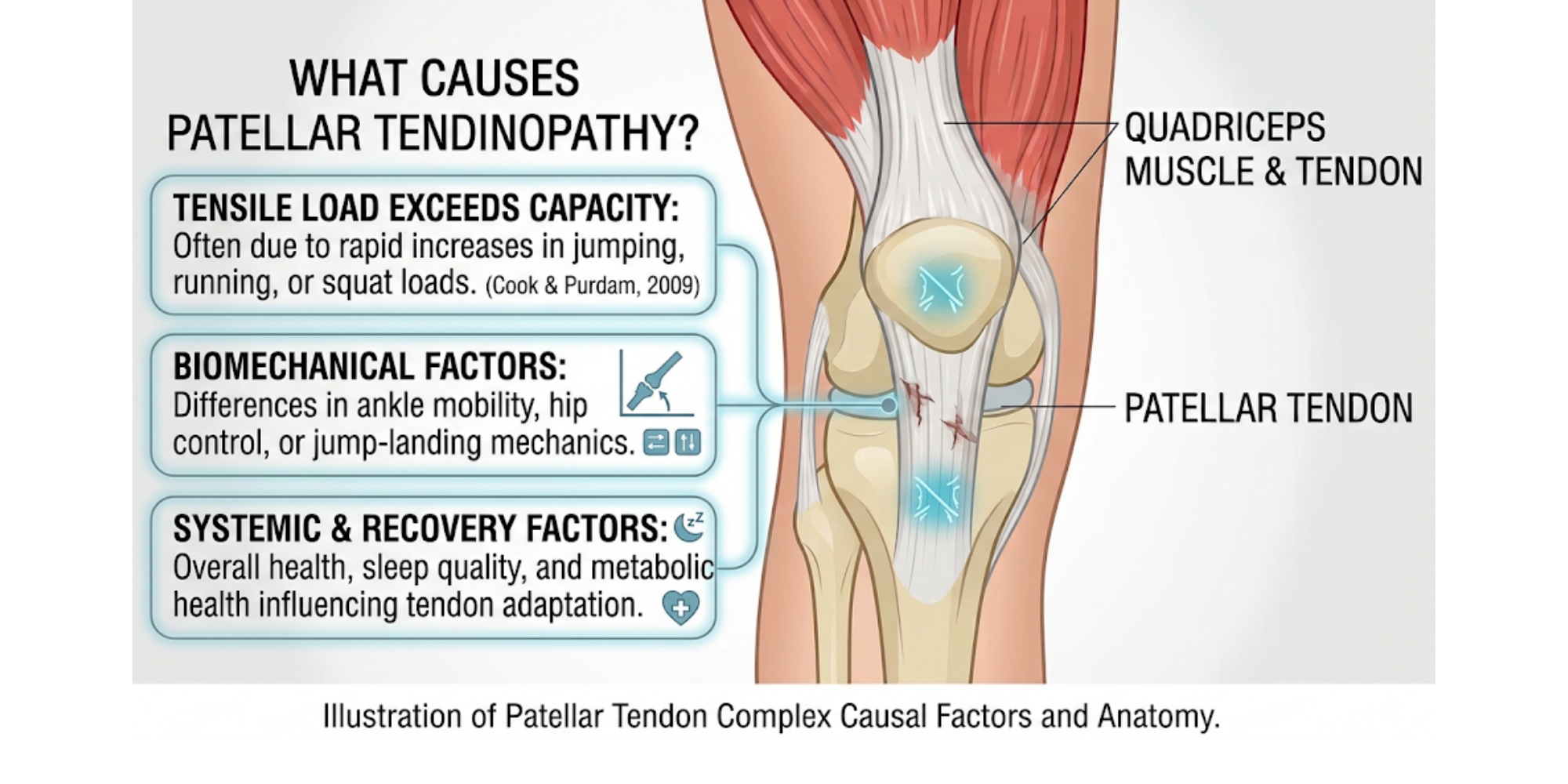
Patellar tendinopathy develops when tensile load exceeds the tendon’s current capacity, often driven by:
-
Rapid training spikes: Sudden increases in jumping volume, running intensity, or squat loads
-
Biomechanical factors: Differences in ankle mobility, hip control, or jump-landing mechanics
-
Systemic and recovery factors: Overall health, sleep quality, and metabolic health influencing tendon adaptation (Cook & Purdam, 2009)
 How We Assess Your Knee
Front-of-knee pain has multiple potential sources—such as patellofemoral pain or fat pad irritation—making an accurate diagnosis essential. We evaluate your symptoms, strength, movement patterns, and specific clinical tests to identify what’s driving your pain and establish your baseline tendon tolerance.
Ready to Find Out What’s Causing Your Pain?
[ Schedule Your Knee Evaluation ]
Your first visit includes a thorough diagnostic assessment, a clear explanation of what is driving your symptoms, and an individualized roadmap to get you safely back to the activities you love.
Why Does Your Pain Keep Coming Back?
It’s rarely as simple as having a “weak quad.” Persistent knee pain is usually influenced by a mismatch between your daily demands and your tendon’s capacity, combined with sudden training shifts or missed kinetic chain strength. Complete rest rarely solves the issue; in fact, resting too much detrains the tendon, causing pain to return the moment you resume normal activity.
Backed by clinical research, our approach focuses on structured, progressive loading rather than passive rest or guesswork (Rio et al., 2015; van der Vlist et al., 2021).
How We Treat Patellar Tendinopathy
Our four-step framework is designed to calm irritation, rebuild your capacity, and transition you back to full performance.
1. Calm Symptoms & Maintain Activation
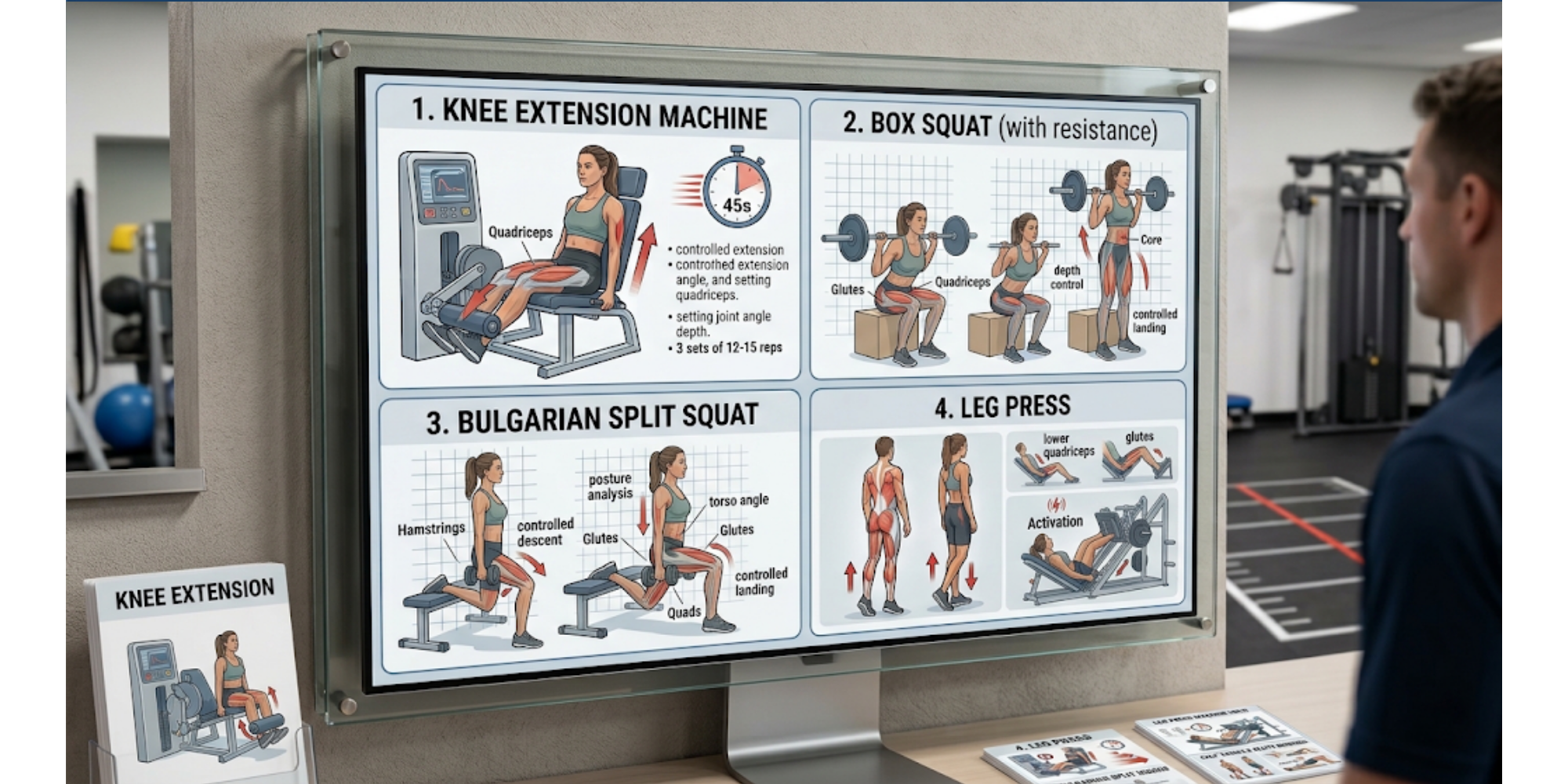
We start by evaluating your mechanics and establishing a baseline load, using targeted exercises like isometric holds to reduce pain while keeping your quadriceps active.
Example: Phase 1 (Weeks 1–2)
Isometric Spanish Squat or Leg Extension Hold: 4–5 sets × 45-second holds at a comfortable knee angle.
Calf Raises & Glute Bridges: 3 sets × 12–15 reps.
Progression Criterion: Exercises feel controlled and symptoms return to baseline by the next morning.
 2. Modify, Don’t Rest
Complete inactivity is rarely necessary. We help you modify training volume, intensity, or aggravating movements so you can stay active while your tendon adapts.
3. Progressively Build Capacity
As your symptoms stabilize, we systematically increase resistance and challenge the tendon through heavy slow resistance (HSR) and energy storage/plyometric progressions. The exact exercises aren’t the point—progressive loading is.
4. Return to Your Activities
We prepare your knee for real-world demands—whether that means sprinting, heavy lifting, hiking, or returning to court sports—building the physical capacity and confidence you need to move without hesitation.
The Stoplight Rule & 24-Hour Response
-
🟢 Green (0–2/10 pain): Continue if pain stays mild and movement remains controlled.
-
🟡 Yellow (3–4/10 pain): Modify the exercise by reducing weight, depth, or speed if symptoms increase slightly.
-
🔴 Red (5+/10, sharp or worsening pain): Stop or significantly reduce the load.
Check your 24-hour response: Symptoms should return to baseline by the next morning. If pain or daily activities like walking downstairs are noticeably worse, reduce the load in your next session.
Pain responses vary between individuals, so these thresholds are general guidelines rather than strict rules. Your response during exercise, how symptoms settle afterward, and how your knee feels the following day should all guide your progression, with adjustments made to suit your individual presentation and stage of recovery.
Measurable Rehabilitation Milestones
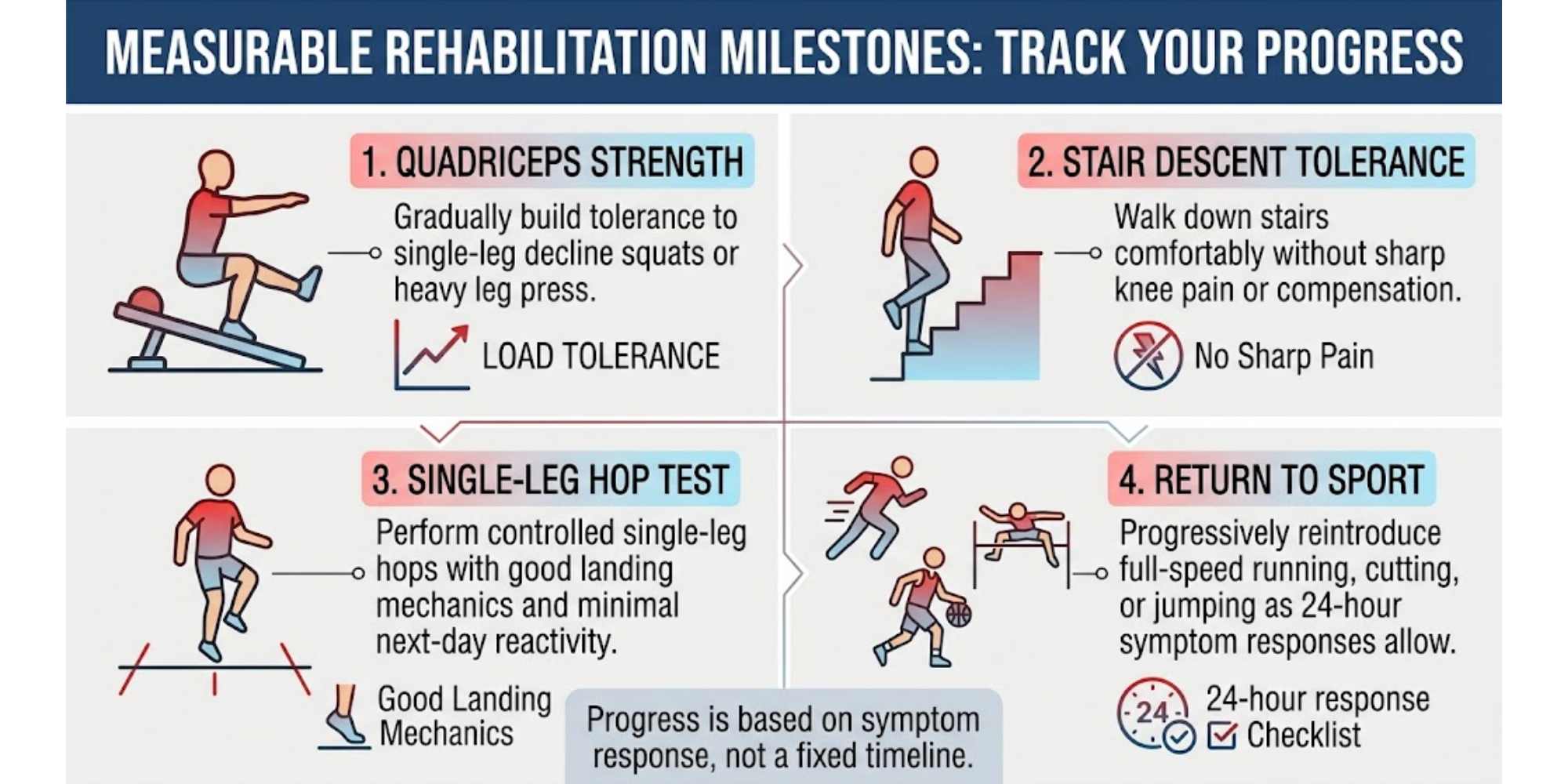
Track your progress using clear, functional benchmarks:
-
Quadriceps strength: Gradually build tolerance to single-leg decline squats or heavy leg press.
-
Stair descent tolerance: Walk downstairs comfortably without sharp knee pain or compensation.
-
Single-leg hop test: Perform controlled single-leg hops with good landing mechanics and minimal next-day reactivity.
-
Return to sport: Progressively reintroduce full-speed running, cutting, or jumping as 24-hour symptom responses allow.
 What to Expect at Your First Appointment
-
Understand your symptoms: We’ll discuss where your pain occurs, what aggravates it, and how it impacts your goals.
-
Get a thorough assessment: We’ll test quadriceps strength, ankle mobility, landing mechanics, and tendon load tolerance while ruling out other knee or hip drivers.
-
Understand what’s driving your pain: We’ll explain our findings in plain language so you know exactly what is causing your symptoms.
-
Leave with a plan: You’ll receive a personalized roadmap with activity modifications, targeted exercises, and a progressive return-to-sport strategy.
Still Dealing With Patellar Tendon Pain?
If knee pain is limiting your running, jumping, workouts, or return to sport, you don’t have to navigate rehabilitation alone. At Performance Sport & Spine in Redmond, WA, we assess your symptoms, strength, training demands, and current tolerance to loading to help develop an individualized plan for recovery.
Whether you’re struggling to progress your exercises or your symptoms keep returning when you increase activity, a personalized assessment can help identify what may be holding you back and guide your next steps.
Ready to take the next step? Schedule an appointment with Performance Sport & Spine to discuss your knee pain and build a plan tailored to your goals.
[ Book Your Initial Evaluation ]
Can’t make it to the clinic, check out a Patellar Tendinoapthy Rehab Program.
 Frequently Asked Questions
Do I need to stop running or jumping completely?
Not necessarily. Complete rest often leads to tendon deconditioning. We typically modify your jump volume, running speed, or squat depth rather than eliminating activity entirely.
Is patellar tendinopathy the same as “runner’s knee”?
Not quite. “Runner’s knee” usually refers to patellofemoral pain syndrome (pain around or behind the kneecap), whereas patellar tendinopathy specifically affects the tendon directly below the kneecap.
Note: While deep knee flexion can increase patellofemoral joint stress, tendinopathy tolerance depends heavily on how load is applied and absorbed, rather than simply how far the knee bends.
How long does patellar tendinopathy take to improve?
Tendons adapt slowly. Recovery timeline depends on symptom duration, baseline strength, and training demands. We use functional milestones rather than arbitrary timelines to guide your progress safely.
Do I need an X-ray or MRI?
In most cases, no. Patellar tendinopathy is diagnosed clinically through a thorough history and physical examination. Imaging is generally reserved for cases that do not respond to progressive loading or where alternative diagnoses are suspected.
Performance Sport & Spine
📞 Call Us: (425) 896-7151
📍 Location: Redmond, WA
✉️ Email: info@performancesportspine.com
References
-
Malliaras, P., Cook, J., Purdam, C., & Rio, E. (2015). Patellar Tendinopathy: Clinical Diagnosis, Load Management, and Advice for Challenging Case Presentations. Journal of Orthopaedic & Sports Physical Therapy, 45(11), 887–898.
-
Cook, J. L., & Purdam, C. R. (2009). Is tendon pathology a continuum? A pathology model to explain the clinical presentation of tendinopathy. British Journal of Sports Medicine, 43(6), 409–416.
-
Rio, E., Kidgell, D., Purdam, C., Gaida, J., Moseley, G. L., Pearce, A. J., & Cook, J. (2015). Isometric exercise induces analgesia and reduces inhibition in patellar tendinopathy. British Journal of Sports Medicine, 49(19), 1277–1283.
-
van der Vlist, A. C., Breda, S. J., Oei, E. H., Verhaar, J. A., & de Vos, R. J. (2021). Clinical risk factors for patellar tendinopathy: a systematic review. British Journal of Sports Medicine, 55(13), 734–740.
Medical Disclaimer
The information provided in this article is for educational and informational purposes only and is not intended to replace professional medical advice, diagnosis, or treatment. Every individual’s condition, symptoms, and response to rehabilitation are different. Exercises and recommendations described here may not be appropriate for everyone, and pain levels or progression guidelines should be adapted to individual needs.
Always consult a qualified healthcare professional regarding knee pain or before beginning a new exercise or rehabilitation program. Stop any activity that causes significant or worsening symptoms and seek appropriate medical evaluation. Do not disregard or delay professional medical advice because of information presented on this website.


