

Low Back Pain: Evidence-Based Treatment & Recovery
If you’ve ever experienced a sudden tweak in your lower back, you know how alarming it can feel. Even a simple movement can trigger significant pain, leaving you wondering whether something has been damaged. It’s natural to want an MRI, identify the exact source of the pain, or rest until it disappears.
However, modern clinical research has changed how healthcare professionals understand and manage low back pain (LBP). Research published in The Lancet and major clinical guidelines increasingly emphasize appropriate assessment, avoiding unnecessary medical interventions, and supporting recovery through education and active rehabilitation.
So, what does the evidence actually recommend?
1. Back Pain Is Not Always a Sign of Structural Damage
One of the most important concepts in modern back pain care is that pain does not automatically mean something in your spine has been damaged.
Most low back pain is classified as nonspecific, meaning that no single underlying structure can be confidently identified as the primary cause. This does not mean the pain is imaginary or that physical factors are unimportant. Rather, pain can reflect a combination of biological, psychological, and lifestyle influences.
Imaging studies frequently reveal disc bulges and age-related degenerative changes in people who have no symptoms. Brinjikji et al. (2015) found that degenerative spinal findings were common in asymptomatic individuals and increased with age. An abnormal MRI therefore does not automatically explain someone’s pain or determine the appropriate treatment.
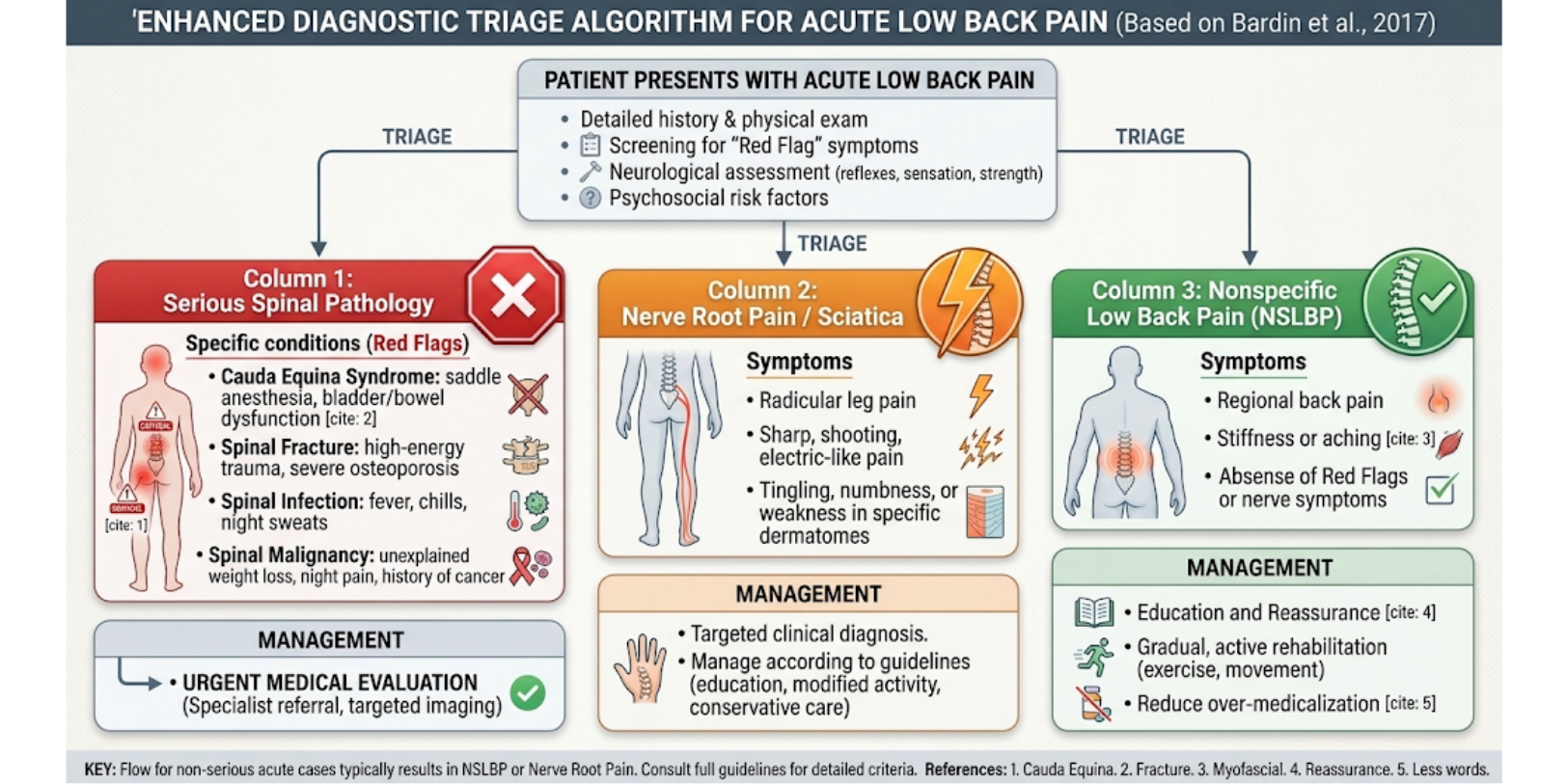
Clinical assessment should consider symptoms, medical history, physical function, and potential warning signs. Bardin et al. (2017) emphasize that the priority is to identify patients who may have serious underlying conditions while appropriately managing the majority who do not.
The takeaway: Back pain can be significant without indicating serious damage, and an imaging finding is not necessarily the cause of your symptoms.
2. The Problem With Over-Medicalization
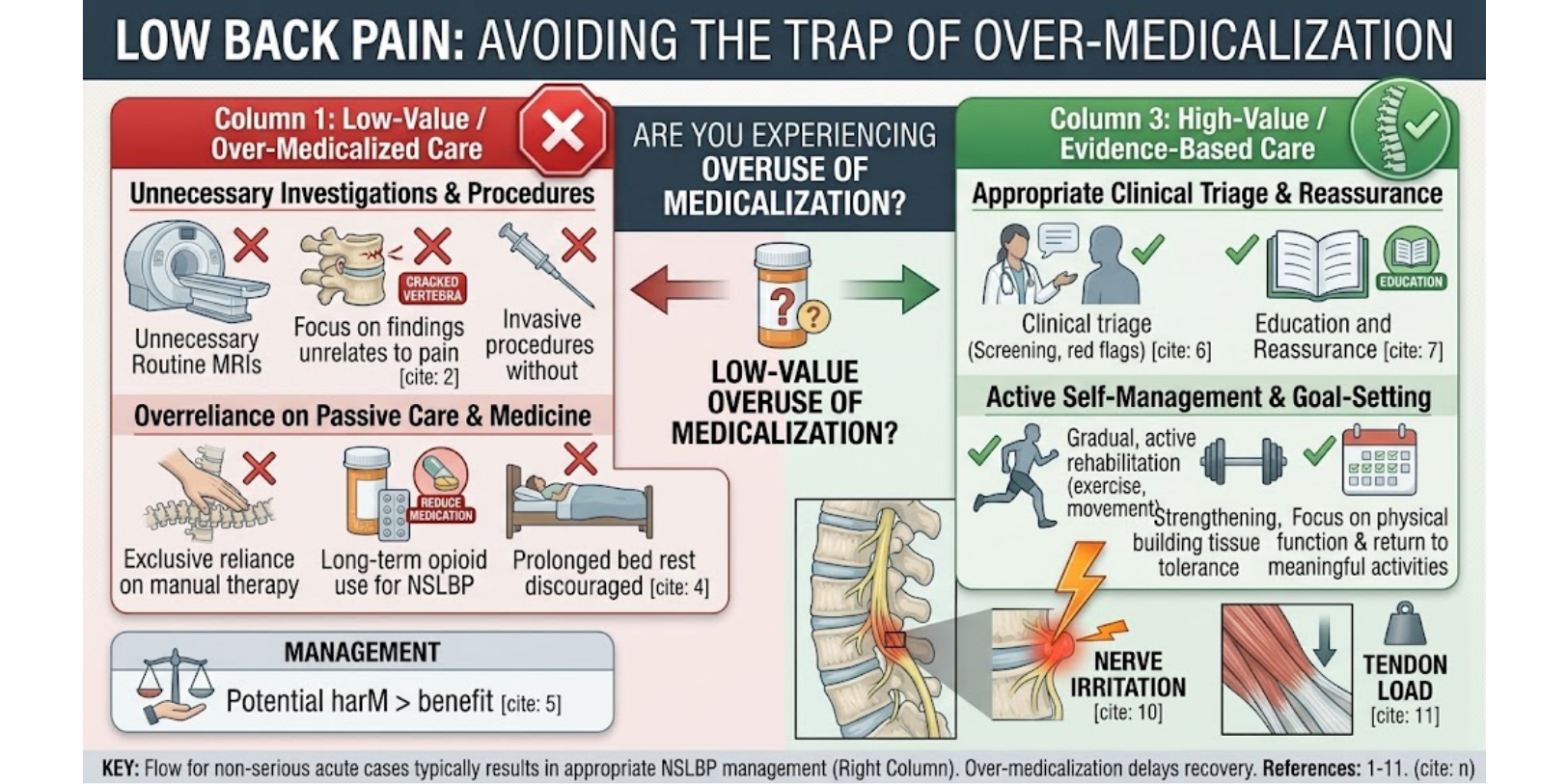
Low back pain is a leading cause of disability worldwide. Yet healthcare systems sometimes rely on investigations and treatments that offer limited benefit.
The Lancet Low Back Pain Series highlighted the widespread use of unnecessary imaging, inappropriate treatments, and excessive reliance on medical interventions. Buchbinder et al. (2018) called for healthcare systems to prioritize evidence-based care that supports function and self-management.
Unnecessary imaging: Routine X-rays or MRIs are generally not recommended for uncomplicated low back pain when there are no concerning clinical features. Imaging may identify common changes that cause unnecessary worry or lead to further procedures without improving recovery. However, imaging remains important when serious pathology is suspected or when results are likely to change treatment decisions.
Passive treatments and spinal adjustments: Treatments such as massage, manual therapy, and spinal adjustments may help some people manage their symptoms. Spinal manipulation, including techniques commonly associated with chiropractic care, has been shown to provide modest improvements in pain and function for some patients with acute and chronic low back pain. A systematic review by Paige et al. (2017), published in JAMA, found that spinal manipulation was associated with modest short-term improvements in pain and function for acute low back pain.
However, adjustments should not be viewed as a way to permanently realign the spine or put a vertebra back into place. Evidence does not establish that nonspecific low back pain is generally caused by vertebrae being misaligned. Instead, manipulation may help reduce symptoms and improve movement tolerance, making it easier to participate in daily activities and rehabilitation.
Manual therapy can therefore be a reasonable treatment option when appropriate, but it is best used alongside education, exercise, and active self-management rather than as the sole treatment strategy. The American College of Physicians includes spinal manipulation among the nonpharmacological options for low back pain (Qaseem et al., 2017).
Overreliance on medication and rest: Prolonged bed rest is generally discouraged, and opioids are not routinely recommended for uncomplicated low back pain because their potential harms may outweigh their benefits.
The goal is not to avoid medical care or hands-on treatment. It is to ensure that investigations and treatments are appropriate, necessary, and likely to improve outcomes.
3. Shifting Toward Active Self-Management
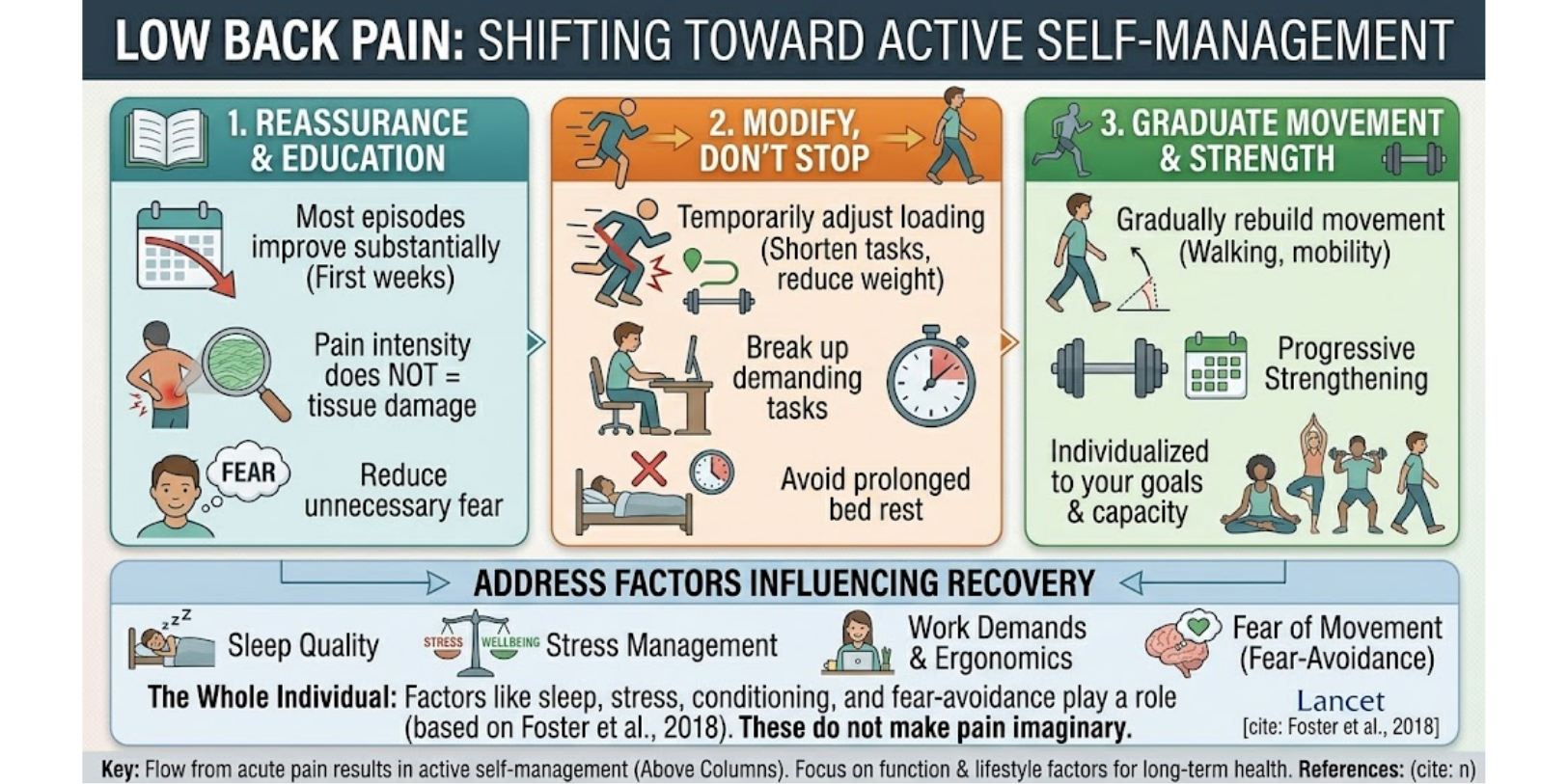
Clinical guidelines and research support education, reassurance, continued activity, and individualized exercise as important components of recovery.
Stay reassured. Most episodes of acute low back pain improve over time, often substantially within the first few weeks, although recovery varies and recurrence is common. Understanding that pain intensity does not reliably indicate the extent of tissue damage can help reduce unnecessary fear.
Modify activity rather than stopping completely. Temporarily adjust activities that significantly aggravate your symptoms. You might reduce lifting loads, shorten walks, or break demanding tasks into smaller sections. Prolonged bed rest is generally not recommended; maintaining tolerable activity helps preserve physical capacity.
Gradually rebuild movement and strength. Walking, mobility exercises, and progressive strengthening can support recovery. The best approach depends on your symptoms, goals, and current capacity. You do not necessarily need to wait until every symptom disappears before becoming active again. Increase activity gradually, and seek professional guidance if symptoms continue to worsen or new concerning symptoms develop.
Address the factors that influence recovery. Sleep, stress, physical conditioning, work demands, and fear of movement can all influence how back pain persists. These factors do not make pain imaginary. They help explain why people with similar imaging findings can experience very different symptoms and outcomes.
As Foster et al. (2018) discuss in The Lancet, effective back pain care should consider the individual as a whole rather than focusing exclusively on spinal structures.
Ready to Get Back to Moving Comfortably?
Low back pain doesn’t always mean something is damaged, and you don’t have to navigate recovery alone. We can help you understand your symptoms, identify the right treatment options, and develop a personalized plan to restore movement, build strength, and get back to the activities you enjoy.
Book an assessment today to take the first step toward recovery.
4. When Should You Seek Medical Assessment?
Although most low back pain is not caused by a serious condition, appropriate assessment remains essential.
Seek emergency medical assessment for new loss of bladder or bowel control, difficulty urinating associated with concerning back symptoms, numbness around the groin or saddle region, or rapidly progressive leg weakness. These symptoms may indicate a time-sensitive neurological problem.
Prompt medical evaluation is also important when back pain occurs alongside significant trauma, fever, a history of cancer, or unexplained weight loss, particularly when the overall clinical picture raises concern for a serious cause.
The Takeaway
Modern low back pain care is not about dismissing symptoms or assuming nothing is wrong. It is about identifying when further investigation is necessary while avoiding unnecessary interventions when they are unlikely to help.
Spinal adjustments can be a reasonable option for selected patients, particularly when they provide short-term symptom relief and help facilitate movement. However, they are not essential for recovery and should not be presented as correcting a misaligned spine.
For many people, recovery involves appropriate assessment, clear education, continued tolerable activity, and gradual rehabilitation that builds strength, confidence, and function.
You do not necessarily need an MRI or an adjustment to begin recovering, nor do you need to identify one specific faulty structure before taking positive steps forward. With appropriate guidance and individualized rehabilitation, many people can regain confidence, improve their function, and return to the activities they enjoy.
Disclaimer: This article is for educational purposes only and does not replace individualized medical advice, diagnosis, or treatment.
References
-
Bardin LD, King P, Maher CG. Diagnostic triage for low back pain: a practical approach for primary care. Med J Aust. 2017;206(6):268–273. https://doi.org/10.5694/mja16.00828
-
Brinjikji W, Luetmer PH, Comstock B, et al. Systematic literature review of imaging features of spinal degeneration in asymptomatic populations. AJNR Am J Neuroradiol. 2015;36(4):811–816. https://doi.org/10.3174/ajnr.A4173
-
Buchbinder R, van Tulder M, Öberg B, et al. Low back pain: a call for action. The Lancet. 2018;391(10137):2384–2388. https://doi.org/10.1016/S0140-6736(18)30488-4
-
Foster NE, Anema JR, Cherkin D, et al. Prevention and treatment of low back pain: evidence, challenges, and promising directions. The Lancet. 2018;391(10137):2368–2383. https://doi.org/10.1016/S0140-6736(18)30489-6
-
Hall AM, Aubrey-Bassler K, Thorne B, Maher CG. Rethinking primary care management of low back pain. Pain. 2021;162(4):1120–1129. https://doi.org/10.1097/j.pain.0000000000002196
-
Paige NM, Arora T, Wright JD, et al. Association of spinal manipulative therapy with clinical benefit and harm for acute low back pain: systematic review and meta-analysis. JAMA. 2017;317(14):1451–1460. https://doi.org/10.1001/jama.2017.3086
-
Qaseem A, Wilt TJ, McLean RM, Forciea MA; Clinical Guidelines Committee of the American College of Physicians. Noninvasive treatments for acute, subacute, and chronic low back pain: a clinical practice guideline from the American College of Physicians. Ann Intern Med. 2017;166(7):514–530. https://doi.org/10.7326/M16-2367
-
de Campos TF, Maher CG, Fuller JT, et al. Exercise programs for preventing episodes of low back pain. Cochrane Database Syst Rev. 2023;1(1):CD015112. https://doi.org/10.1002/14651858.CD015112.pub2
Dr. Zach Greenwade, DC, MS, provides sports chiropractic and rehabilitation at Performance Sport & Spine. His approach combines clinical assessment, hands-on treatment when appropriate, and progressive rehabilitation to help patients return to their daily activities and sport.


