

By Dr. Zach Greenwade, DC, MS | Published: September 8th, 2026
If you are dealing with outer hip pain, lateral hip tightness, or gluteal tendinopathy, stretching can often feel like a double-edged sword. Traditional static stretches—like pulling your knee across your chest or performing a figure-four stretch—often compress the gluteal tendons against the greater trochanter, exacerbating pain and inflammation.
Watch the full video on our YouTube Channel
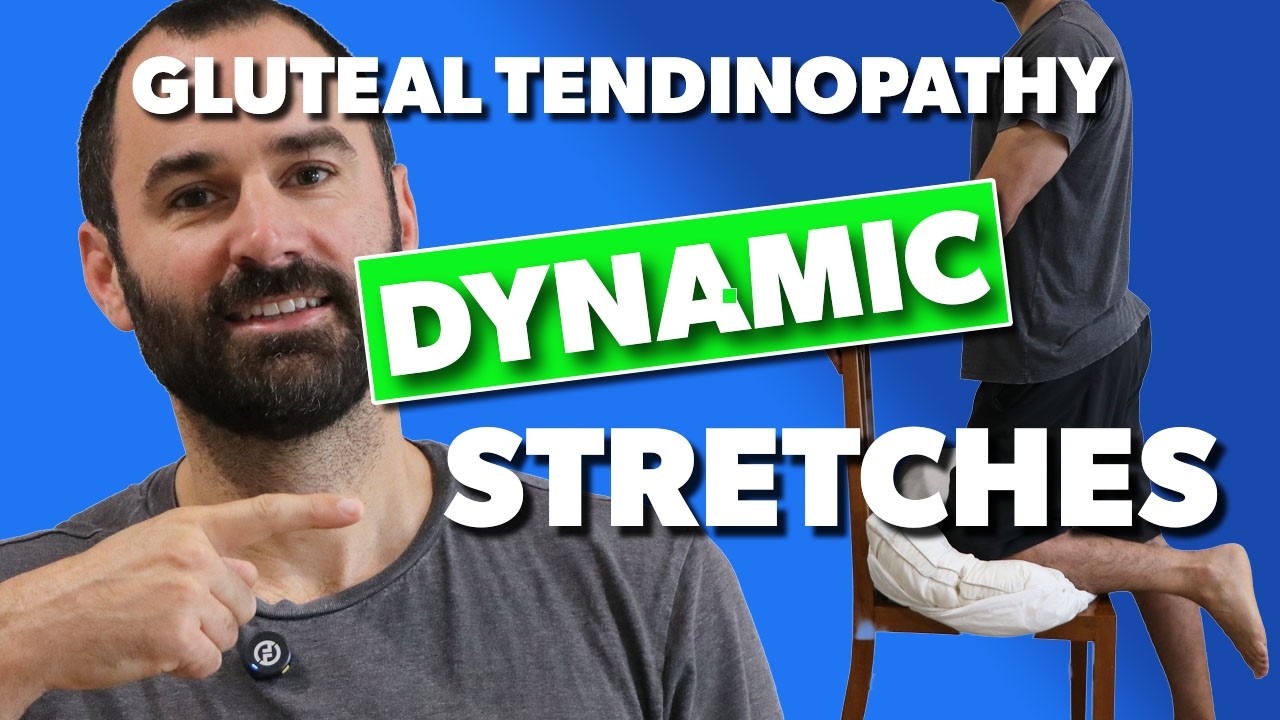
To safely restore mobility, improve blood flow, and loosen the hips without irritating the tendon, dynamic stretching is often the superior approach.
Here are four effective, standing dynamic stretches designed specifically for gluteal tendinopathy. None of these exercises require getting down on the floor.
Prefer static stretches? If you find static stretching more comfortable, you can explore our guide here: Safe Static Stretches
1. Chair-Supported Dynamic Hip Flexor & Glute Drive
This exercise opens up the front of the hip while engaging the glute on the trailing leg without putting compressive load on the lateral tendon.
How to do it:
-
Place a chair in front of you and position a pillow on the seat to cushion your shin.
-
Place your target leg (the painful hip) forward, keeping your stance wide.
-
Gently rock forward into a lunge-like motion, lightly squeezing your glute as you drive forward. You can prop up on the toe of your back foot if needed.
-
Move continuously: rock in to feel a smooth stretch, then return to the starting position.
-
Perform 8 reps for 2 sets on each side, focusing on moving through the hip rather than arching your lower back.
 2. Wide-Stance Supported Knee-to-Chest
This dynamic pull targets deep hip capsule mobility without bringing the thigh across the body.
How to do it:
-
Stand tall, maintaining a wide base of support. Stay upright on your standing leg so you do not collapse into the target hip.
-
Hold onto a wall or sturdy object for balance with one hand.
-
Actively lift your knee toward your chest using your hip flexors, then use your free hand to pull the leg up slightly further for a gentle end-range stretch.
-
Keep the knee aligned slightly outside or directly in line with your shoulder—do not pull the leg across your midline.
-
Lower the leg back down immediately. Perform 8 reps for 2 sets on each side, pulling only to the point of mild tension.
 3. Standing Dynamic Quadriceps Mobility (Heel-to-Buttocks)
Tightness in the anterior thigh can alter hip mechanics and increase stress on the lateral gluteal structures. This dynamic movement warms up the quadriceps safely.
How to do it:
-
Stand upright near a chair or wall for support, keeping your standing leg wide and stable.
-
Lift one heel straight up toward your glute, reaching back to gently guide your foot if comfortable, or simply using your hamstring strength to draw the heel up.
-
Ensure your knee points straight down and does not drift inward across your midline.
-
Lower the foot back to the floor immediately to reset.
-
Repeat for 8 dynamic reps for 2 sets per leg, ensuring you stay tall through your pelvis throughout the motion.
 4. Wide-Stance Dynamic Leg Swings
Dynamic swings promote synovial fluid movement in the hip joint, reducing morning stiffness and increasing overall comfort.
How to do it:
-
Place both hands on the back of a sturdy chair for balance.
-
Set your standing foot slightly wider than shoulder-width apart to protect the stance-side hip.
-
Gently swing your active leg forward and backward in a controlled, rhythmic motion.
-
Focus on smooth momentum rather than maximum height, keeping the movement painless.
-
Complete 8 swings per leg for 2 sets.
 Ready for Personalized Rehabilitation?
If outer hip pain is interfering with your daily activities, walking, or sleep, getting a comprehensive physical assessment is key to long-term relief.
Continue Your Gluteal Tendinopathy Recovery
- Targeted Rehab: The Best Isometric & Progressive Loading Exercises for Gluteal Tendinopathy
- Exercise Selection: Why Clam Exercises May Not Be the Best Starting Point—and What to Do Instead
- Nighttime Relief: How to Sleep With Lateral Hip Pain Without Irritating the Tendon
- Daily Movement: Walking Modifications That Can Reduce Hip Irritation
- Daily Habits: Posture and Lifestyle Changes for Lateral Hip Pain
Frequently Asked Questions (FAQ)
Why should I avoid static stretches for gluteal tendinopathy?
Traditional static stretches often involve crossing the leg across the body (adduction) or deep hip flexion, which compresses the gluteus medius and minimus tendons against the outer hip bone (greater trochanter). Dynamic movement promotes circulation and mobility without this prolonged compressive stress.
How often should I perform these dynamic stretches?
Because these movements are low-load and dynamic, they can be performed 1–2 times daily. They work particularly well as a morning mobility routine to ease stiffness or as a warm-up before walking.
What if an exercise causes pain?
Always work within a pain-free range of motion. If you experience sharp or increasing pain, reduce the depth of your movement or skip that specific stretch. Rehabilitation should feel supportive, not painful.
About the Author
Dr. Greenwade, DC, MS is an evidence-based sports chiropractor, movement specialist, and the founder of Performance Sport & Spine, serving patients across the Eastside in Redmond and Seattle. Holding a Master of Science in sports medicine alongside a Doctorate of Chiropractic, Dr. Greenwade specializes in modern physical medicine, progressive loading, and active, movement-based recovery. The clinic’s mission is to help active individuals and office professionals resolve acute and chronic musculoskeletal conditions without unnecessary injections, medications, or surgeries.
Medical Disclaimer: The information provided in this article, including text, graphics, images, and other material, is for educational and informational purposes only. It is not intended to be a substitute for professional medical advice, diagnosis, or treatment. Always seek the advice of a qualified healthcare provider with any questions you may have regarding a medical condition or treatment plan.


