

By Dr. Zach Greenwade, DC, MS | Published: October 10th, 2026
Think you need a room full of heavy machinery to build functional strength and recover from joint or tendon pain? Think again. A single elastic band is all it takes to transform your home routine into a targeted, full-body rehab therapy session.
📺 Play-Along Video

The Science: Why Resistance Training Matters
Whether you are recovering from gluteal tendinopathy or simply striving to stay active, resistance training is an essential component of long-term mobility and health.
-
Muscular Strength & Physical Function: Resistance training stimulates muscle protein synthesis, reinforces tendon resilience, and preserves bone density. A comprehensive umbrella review published in Journal of Sport and Health Science / Sports Medicine literature demonstrated that structured resistance exercise consistently improves skeletal muscle mass, peak force, and overall functional performance across all adult age groups (McLeod et al., 2024).
-
Tendon Rehabilitation & Pain Management: For condition-specific rehabilitation like gluteal tendinopathy, controlled progressive load is key. A systematic review published in the British Journal of Sports Medicine highlighted that resistance exercise prescribing appropriate tension and load intensity provides superior outcomes for tendon healing and functional recovery compared to rest or passive therapies (Pavlova et al., 2023).
Resistance bands provide a versatile, joint-friendly way to apply this progressive load without needing bulky gym equipment.
6-Step Full-Body Resistance Band Routine
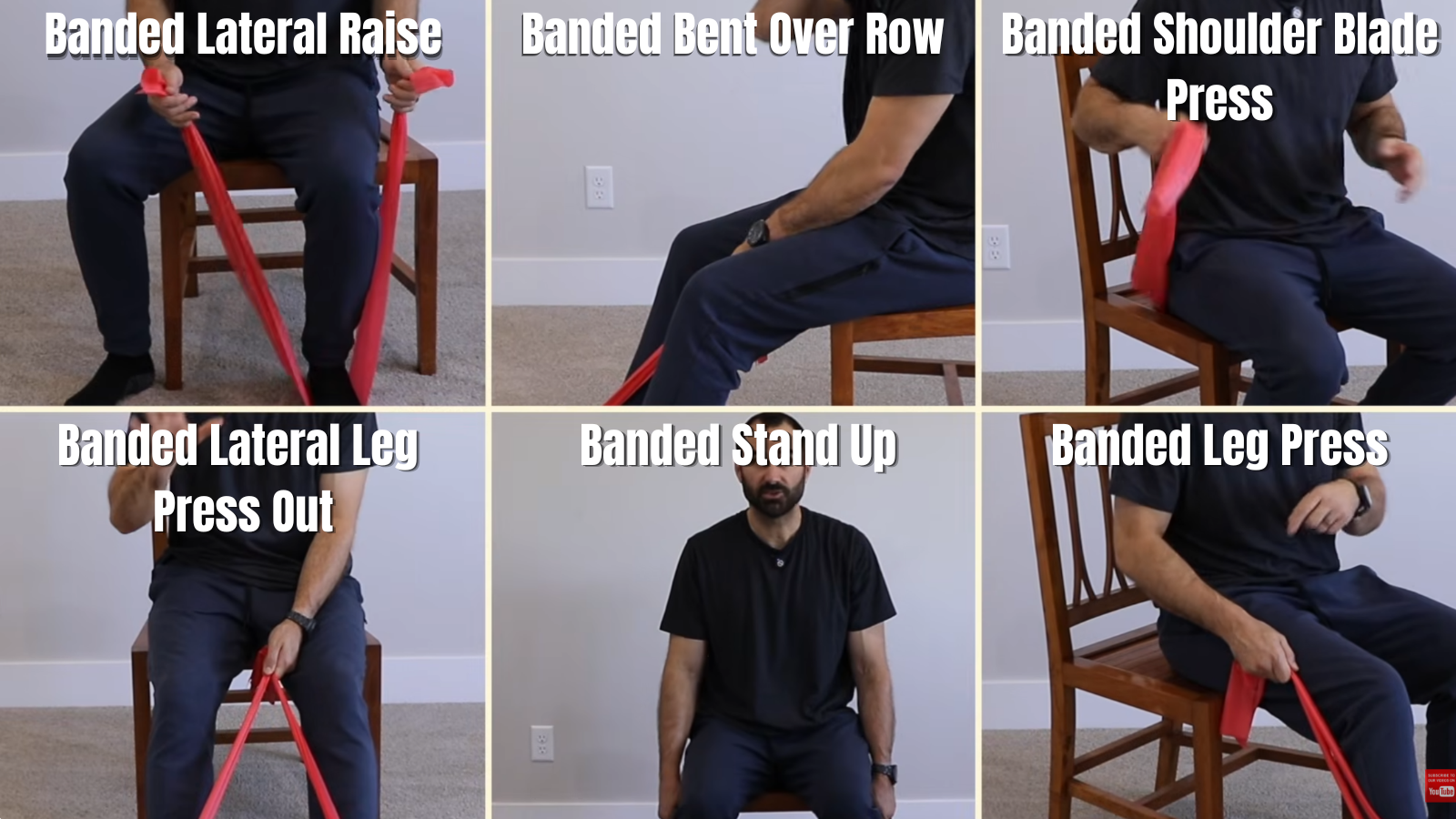
1. Seated Leg Slide (Quadriceps & Knee Extension)
-
Setup: Sit forward on your chair. Loop the band around your working ankle while holding tension with your hand on the same side.
-
Movement: Press your foot outward by fully straightening your knee to 180°. Keep your heel sliding against the floor.
-
Rehab Tip: If managing gluteal tendinopathy, keep your feet spaced out and avoid bringing them across your body’s midline.
-
Volume: 2 sets of 8 reps per leg.
2. Resisted Sit-to-Stand (Glutes & Lower Body)
-
Setup: Place your feet wider than shoulder-width apart over the center of the band. Anchor the ends in your hands with tension while seated.
-
Movement: Drive through your feet into the floor to stand up straight.
-
Form Focus: Drive straight up through your legs rather than leaning forward or pulling with your lower back.
-
Volume: 2 sets of 8 reps (20-second rest between sets).
📅 Ready for Personalized Care?
If you are managing persistent hip, knee, or shoulder pain, generic routines may only get you so far. Schedule a 1-on-1 consultation with our clinical physical therapy team today!
3. Seated Outer Hip Abduction (Gluteus Medius)
-
Setup: Wrap the band around both feet while seated, maintaining a wide stance.
-
Movement: Press one foot outward against the band’s resistance while keeping your back stable, then alternate legs.
-
Rehab Tip: Isolating the gluteus medius builds crucial side-hip strength to protect the lateral hip tendons.
-
Volume: Start with 6 reps per side and work up to 2 sets of 10 reps.
4. Shoulder Blade Press (Chest & Anterior Shoulders)
-
Setup: Wrap the band behind your back and under your armpits, holding each end firmly.
-
Movement: Press your hands straight forward, engaging your chest and front shoulder muscles.
-
Form Focus: Keep a subtle bend in your elbows or press straight outward while keeping control on the return.
-
Volume: 2 sets of 8 reps.
Ready for a Complete 12-Week Protocol?
If you want a fully structured, day-by-day blueprint to eliminate outer hip pain, check out our comprehensive digital guide:
👉 Download the 12-Week Gluteal Tendinopathy Protocol Online

5. Seated Banded Row (Lats & Mid-Back)
-
Setup: Anchor the band under both feet. Hinge forward slightly at the hips with a flat back.
-
Movement: Pull the band back toward your torso, skimming your elbows close by your sides. Squeeze your shoulder blades together at the top.
-
Volume: 2 sets of 8 reps.
6. Controlled Front Raise (Anterior Deltoids)
-
Setup: Anchor the center of the band under one foot and hold the ends with straight arms.
-
Movement: Slowly raise your arms in front of you to approximately 70° (below shoulder height).
-
Caution: Avoid lifting past shoulder level or rushing the motion to prevent shoulder impingement or strain.
-
Volume: 1 to 2 sets of 6 reps.
Summary Table
| Exercise | Primary Target | Reps / Sets | Key Form Cue |
| Leg Slide | Quadriceps | 2 × 8 reps/side | Full knee extension (180°); keep feet wide. |
| Sit-to-Stand | Glutes & Quads | 2 × 8 reps | Press floor away; don’t pull with back. |
| Hip Abduction | Gluteus Medius | 2 × 6–10 reps | Slide heel out; maintain back posture. |
| Shoulder Press | Chest & Shoulders | 2 × 8 reps | Drive hands outward under control. |
| Seated Row | Lats & Upper Back | 2 × 8 reps | Keep elbows close to your sides. |
| Front Raise | Front Deltoids | 1–2 × 6 reps | Limit height to 70°; do not force height. |
About the Author
Dr. Greenwade, DC, MS is an evidence-based sports chiropractor, movement specialist, and the founder of Performance Sport & Spine, serving patients across the Eastside in Redmond and Seattle. Holding a Master of Science in sports medicine alongside a Doctorate of Chiropractic, Dr. Greenwade specializes in modern physical medicine, progressive loading, and active, movement-based recovery. The clinic’s mission is to help active individuals and office professionals resolve acute and chronic musculoskeletal conditions without unnecessary injections, medications, or surgeries.
Medical Disclaimer
Disclaimer: The information provided in this article, including text, graphics, images, and other material, is for educational and informational purposes only. It is not intended to be a substitute for professional medical advice, diagnosis, or treatment. Always seek the advice of a qualified healthcare provider, such as a sports chiropractor, physical therapist, or medical doctor, with any questions you may have regarding a medical condition or treatment plan. Never disregard professional medical advice or delay seeking it because of something you have read on this website.


