

By Dr. Zach Greenwade, DC, MS | Published: October 19th, 2026
Do you have a deep, persistent ache beneath your buttock that gets worse when sitting, sprinting, or performing deep squats? These symptoms can be associated with proximal hamstring tendinopathy, sometimes called high hamstring tendinopathy.
This condition affects the tendons connecting the hamstring muscles to the sit bone (ischial tuberosity). It can interfere with everyday activities, exercise, and sports, but a tailored rehabilitation program can help many people improve their symptoms and rebuild strength.
In this guide, we’ll explain what causes proximal hamstring tendinopathy, how to manage aggravating activities, and how progressive rehabilitation can help you return to the activities you enjoy.
Prefer video? Watch our complete proximal hamstring tendinopathy guide featuring Dr. Zach Greenwade at Performance Sport & Spine.
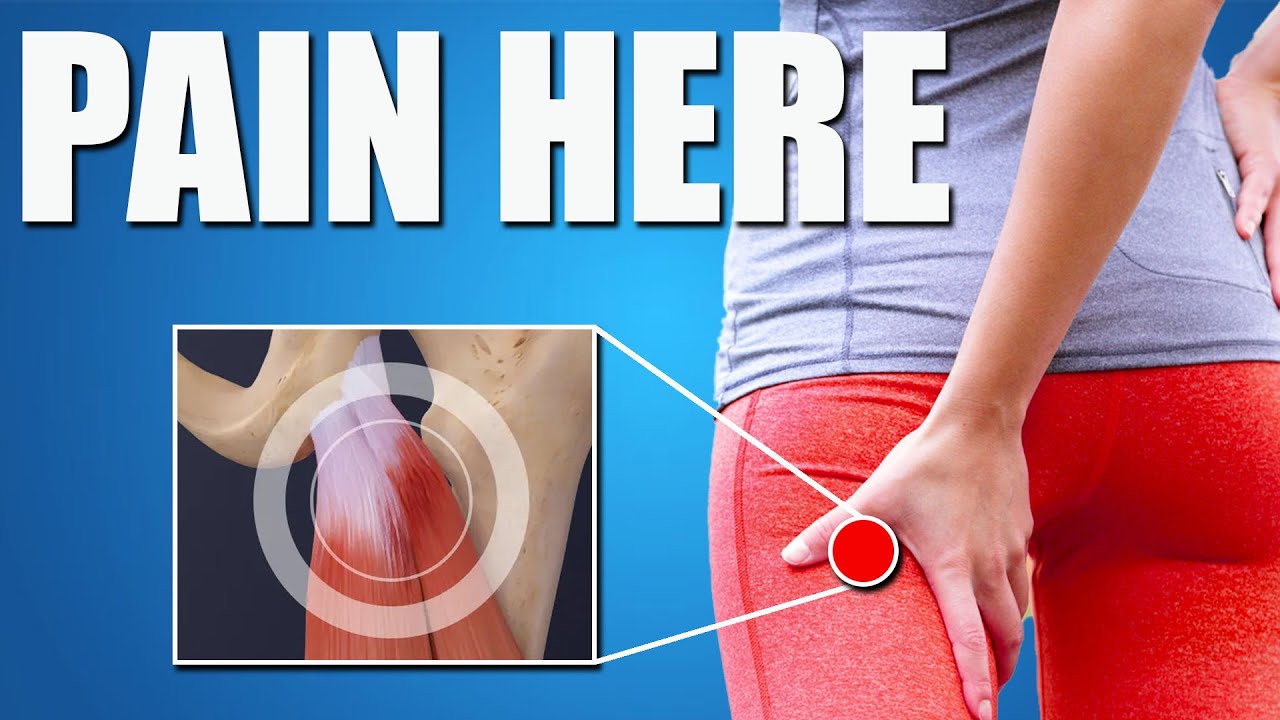
What Is Proximal Hamstring Tendinopathy?
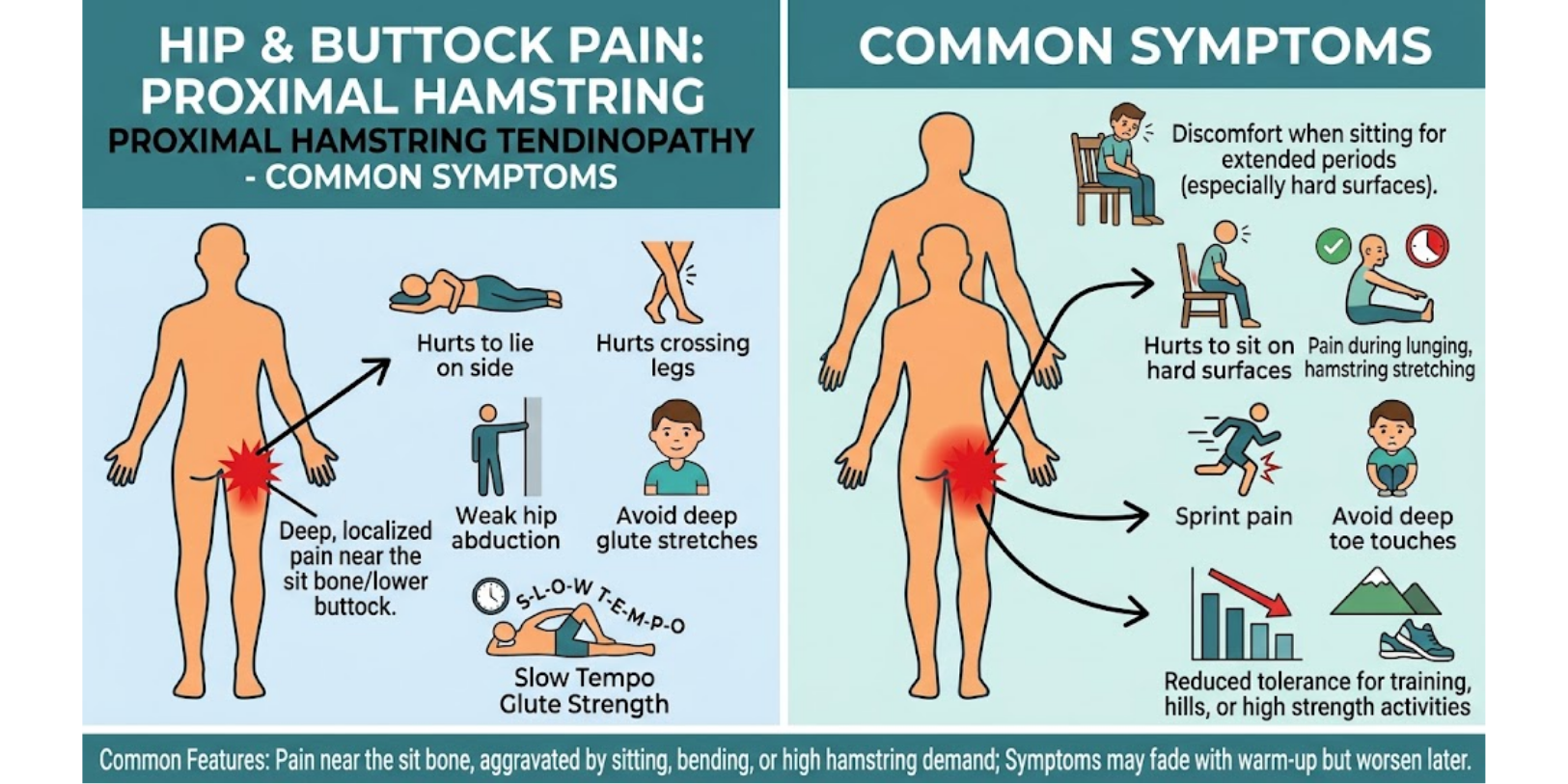
The hamstring muscle group includes the semitendinosus, semimembranosus, and biceps femoris. The proximal hamstring tendons attach these muscles near the ischial tuberosity, the bony prominence you sit on.
Proximal hamstring tendinopathy develops when the tendons near this attachment become painful and less tolerant of loading. Symptoms can occur in athletes and people who are less physically active.
Because the tendons sit close to the hip joint and sciatic nerve, other conditions can also cause deep buttock pain. A clinical assessment can help distinguish hamstring tendinopathy from problems involving the lower back, hip joint, or surrounding nerves (Goom et al., 2016).
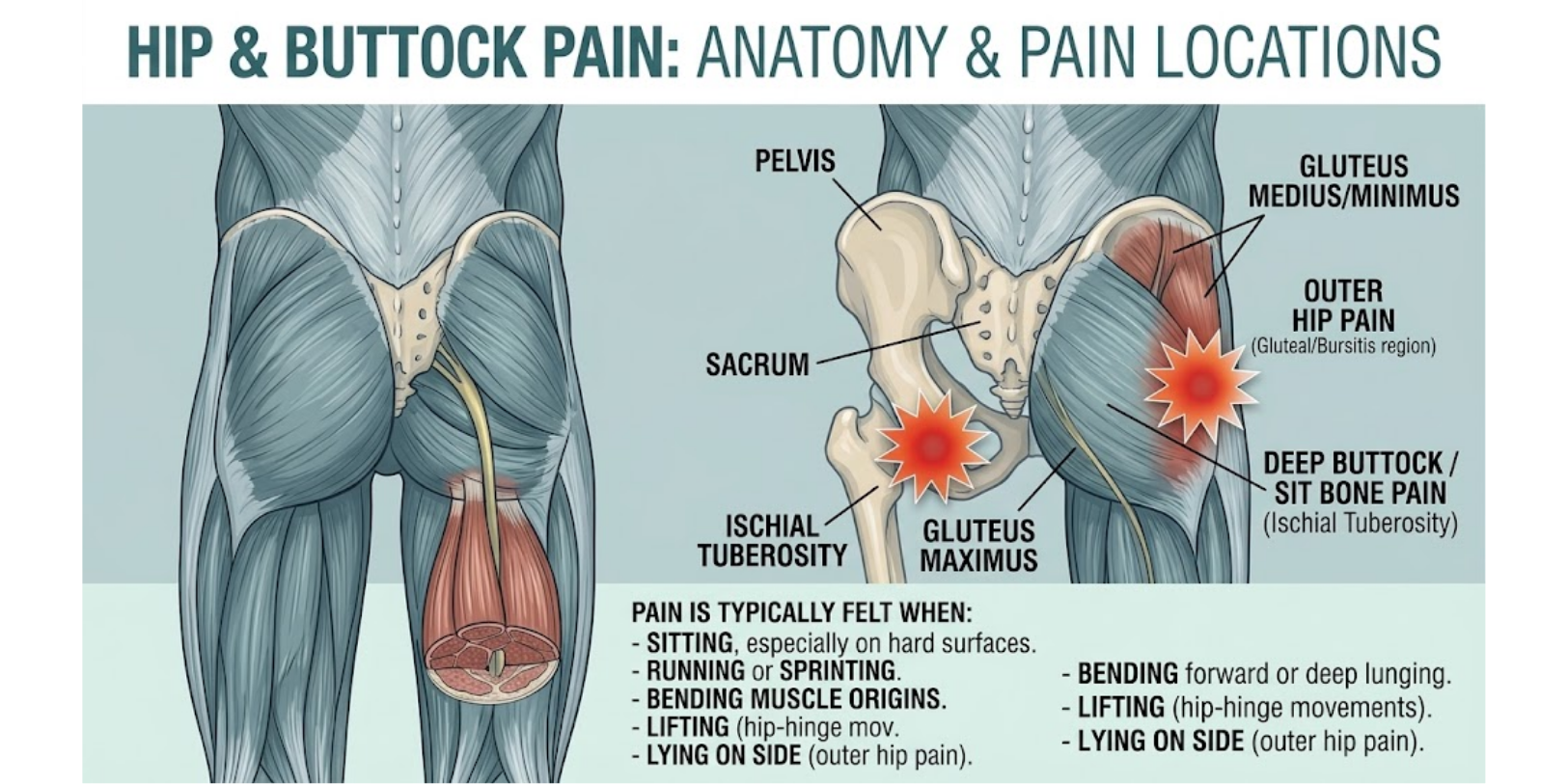
Common Symptoms
Symptoms vary, but common features include:
- Deep, localized pain near the sit bone or lower buttock.
- Discomfort when sitting for extended periods, particularly on hard surfaces.
- Pain during running, sprinting, lunging, deep squats, or hip-hinge exercises.
- Symptoms that ease during a warm-up but return later or the following day.
- Reduced tolerance for training, hills, or activities requiring greater hamstring strength.
These symptoms do not confirm a diagnosis on their own. Sudden pain after a forceful movement, particularly with a popping sensation, significant bruising, or marked weakness, may indicate a hamstring tear or tendon avulsion and warrants prompt medical evaluation.
 What Causes Proximal Hamstring Tendinopathy?
Tendons adapt to the loads placed on them, but problems can develop when training demands increase faster than the tissue can tolerate.
Common contributing factors include:
- A sudden increase in running distance, sprinting, hills, or training intensity.
- Repeated deep hip-flexion movements under heavy loads.
- Insufficient recovery between demanding training sessions.
- Returning to sport too quickly after an injury or period of reduced activity.
Hip flexion can increase compression of the proximal hamstring tendon against the sit bone. When combined with substantial loading, this may aggravate symptoms in some people.
The goal is not to avoid loading the tendon indefinitely. Instead, rehabilitation aims to manage aggravating loads initially and progressively rebuild the strength and capacity needed for everyday activities and sport (Degen, 2019).
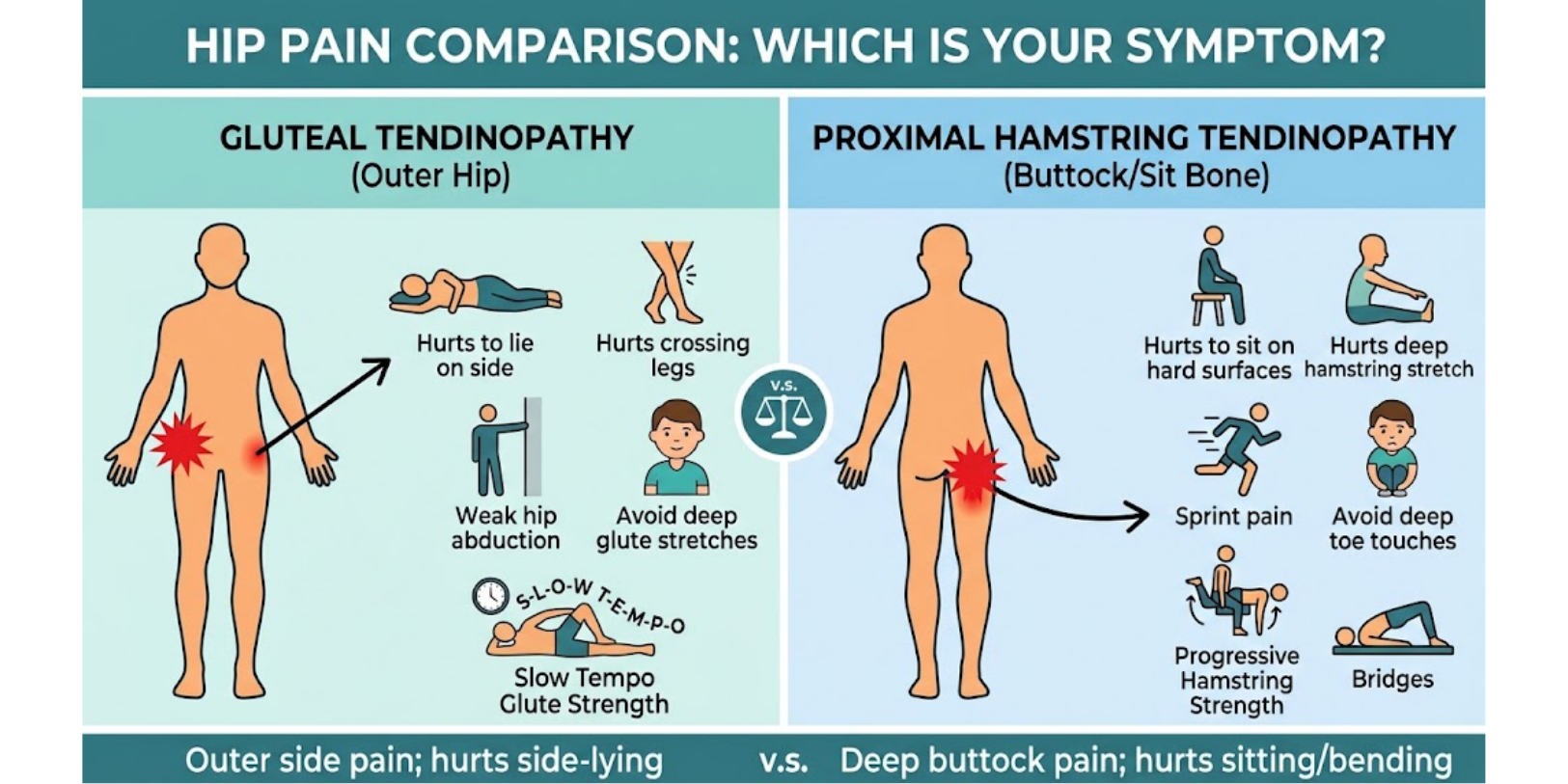
Could It Be Gluteal Tendinopathy Instead?
Pain around the buttock and hip can have different causes. Gluteal tendinopathy (blog here) affects the tendons on the outside of the hip, whereas proximal hamstring tendinopathy typically causes pain near the sit bone beneath the buttock. The table below highlights some common differences.
 Step 1: Modify Activities That Aggravate Symptoms
You generally do not need complete rest. However, temporarily modifying activities that consistently worsen your symptoms can help make rehabilitation more manageable.
Adjust your training. Reduce or modify sprinting, steep hills, heavy deep squats, and other provocative activities. Maintain comfortable activities, such as walking or alternative exercise, when tolerated.
Make sitting more comfortable. Try a cushioned seat, change positions regularly, and take brief standing or walking breaks. Adjusting your seat height to reduce excessive hip flexion may also help.
Avoid aggressive stretching initially. Deep hamstring stretches can increase compression around the tendon attachment. If stretching reproduces your familiar pain, reduce the range or temporarily leave it out.
Monitor how you feel during activity and over the following 24 hours. If symptoms remain noticeably worse the next day, your recent activity may have exceeded your current tolerance.
 Step 2: Build Strength With Progressive Rehabilitation
Exercise-based rehabilitation is commonly recommended for proximal hamstring tendinopathy. The appropriate starting point depends on symptom severity, current strength, and activity goals. The evidence does not establish one exercise program as universally superior, so progression should be individualized (Rich et al., 2025).
A rehabilitation program may include the following stages.
Stage 1: Establish a tolerable starting load
Begin with comfortable hamstring contractions or supported bridge variations. The initial aim is to maintain muscle engagement and build tolerance without substantially aggravating symptoms.
Stage 2: Build strength
Progress toward controlled hamstring exercises, such as bridges, hamstring curls, and other strengthening movements selected for your abilities. Resistance and repetitions can increase as your symptoms and strength allow.
Stage 3: Introduce greater hip flexion
When appropriate, gradually add exercises such as Romanian deadlifts, hip hinges, and lunges. Start with a comfortable range and light resistance before progressing to deeper positions or heavier loads.
Stage 4: Prepare for running and sport
People returning to sprinting or field sports may need progressively faster movements, jumping, bounding, and sport-specific drills. These should be introduced when strength and functional tolerance are sufficient—not simply because a certain number of weeks has passed.
A physical therapist can help determine when to progress, which exercises are appropriate, and how to adapt the program if symptoms flare.
Step 3: Monitor Your Progress
Mild discomfort does not necessarily mean an exercise is causing damage. However, pain should remain manageable, and symptoms should not show a persistent worsening trend.
Use these general guidelines:
- Start with a manageable exercise load and progress gradually.
- Monitor symptoms during exercise and over the next 24 hours.
- Reduce resistance, range of motion, or training volume if symptoms repeatedly flare.
- Track functional improvements, such as sitting longer, walking comfortably, or returning to modified training.
There is no single pain score or daily test that determines whether the tendon is ready for progression. Your overall symptom pattern, strength, and activity tolerance matter.
Could It Be Sciatica Instead?
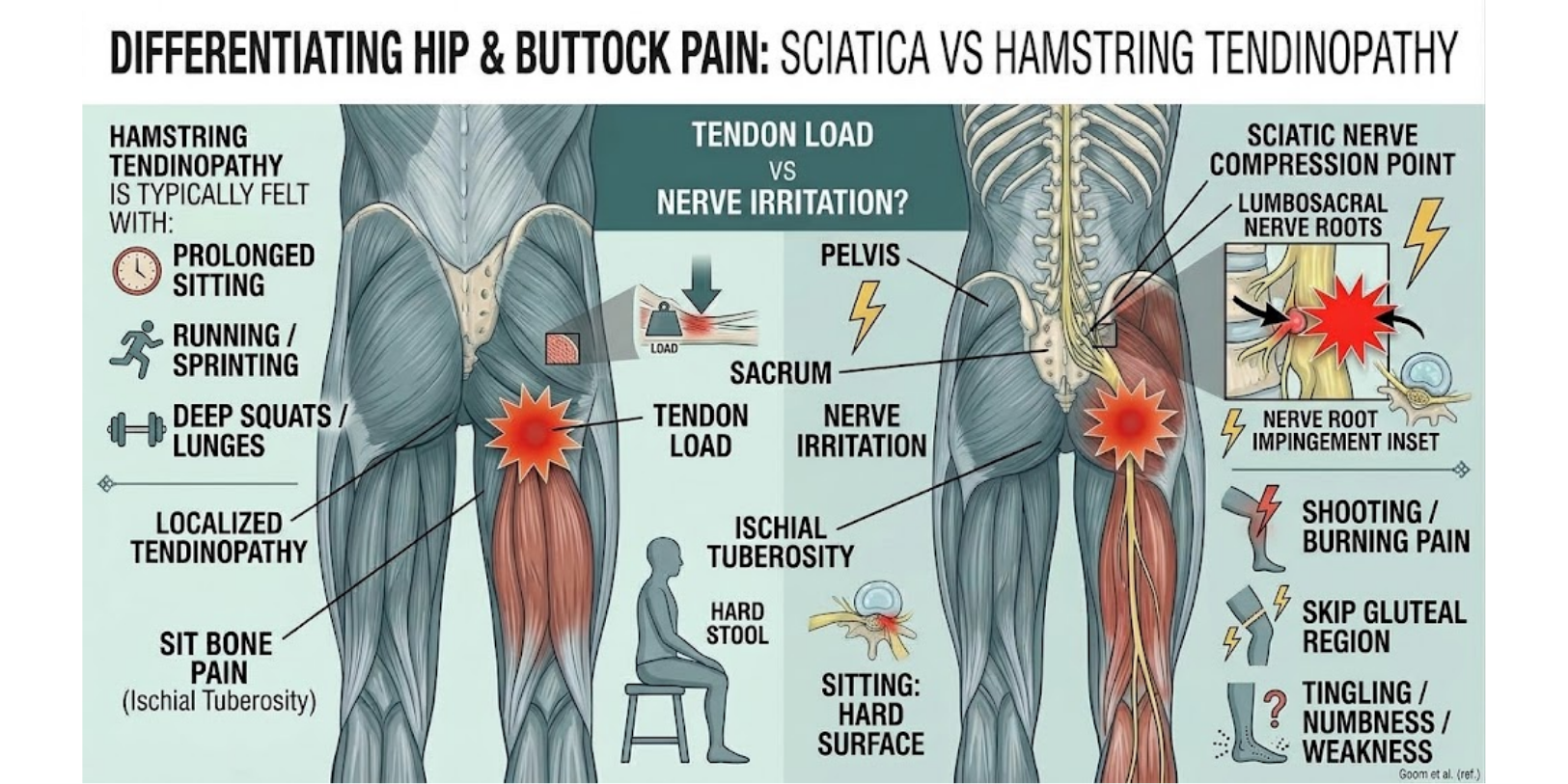
Proximal hamstring tendinopathy can sometimes mimic sciatica, but there are clues that may help distinguish them. Hamstring tendinopathy typically causes localized pain near the sit bone, often aggravated by prolonged sitting, running, or exercises that load the hamstrings. Sciatica is caused by irritation or compression of the sciatic nerve or its nerve roots and may cause shooting, burning, or electric-like pain that travels down the leg, sometimes with tingling, numbness, or weakness.
 Frequently Asked Questions
Can I run with proximal hamstring tendinopathy?
It depends on symptom severity and running demands. Some people can continue modified running, while others need a temporary reduction or break from sprinting and hills. Return to running should be gradual and based on symptom response, strength, and tolerance for progressively faster activity.
Why does sitting make my buttock pain worse?
Sitting can compress the proximal hamstring tendon against the sit bone, particularly when the hip is deeply flexed. Cushioned seating, regular position changes, and temporarily limiting prolonged sitting may help.
How long does recovery take?
Recovery varies with symptom duration, severity, training demands, and other individual factors. Improvement may take several weeks or months, particularly when returning to high-speed running or competitive sport. Consistent, appropriately progressed rehabilitation is generally more useful than repeatedly resting and returning abruptly to the same workload.
Should I stretch my hamstrings?
Not necessarily during the more irritable stages. Deep stretching may aggravate symptoms in some people. Your rehabilitation plan can reintroduce greater range of motion as your tolerance improves.
Ready to Get Back to Moving Comfortably?
Persistent pain beneath the buttock can make sitting, exercise, and sport frustrating. At Performance Sport & Spine, an individualized assessment can help identify likely contributors to your symptoms and guide an appropriate rehabilitation plan.
Call (425) 896-7151 or book an appointment with Performance Sport & Spine in Redmond, WA to discuss your symptoms and recovery goals.
References
- Goom TSH, Malliaras P, Reiman MP, Purdam CR. Proximal hamstring tendinopathy: clinical aspects of assessment and management. Journal of Orthopaedic & Sports Physical Therapy. 2016;46(6):483–493. https://doi.org/10.2519/jospt.2016.5986
- Degen RM. Proximal hamstring injuries: management of tendinopathy and avulsion injuries. Current Reviews in Musculoskeletal Medicine. 2019;12(2):138–146. https://doi.org/10.1007/s12178-019-09541-x
- Nasser AM, et al. Proximal hamstring tendinopathy: a systematic review of interventions. International Journal of Sports Physical Therapy. 2021;16(2):288–299. https://pmc.ncbi.nlm.nih.gov/articles/PMC8016446/
- Rich A, Cook J, Hahne A, Ford J. Treatment of proximal hamstring tendinopathy with individualized physiotherapy: a clinical commentary. International Journal of Sports Physical Therapy. 2025;20(6):892–910. https://doi.org/10.26603/001c.138308
Medical Disclaimer: This article is for educational purposes only and does not constitute medical advice, diagnosis, or treatment. It is not a substitute for an assessment by a qualified healthcare professional. Exercise suitability varies between individuals. Seek prompt medical evaluation for sudden severe pain, significant bruising, marked weakness, or difficulty walking following an injury. Consult a qualified healthcare professional before beginning a new rehabilitation program if you have a recent injury or ongoing symptoms.


